

Veteran artist Satish Gupta, in his largest-ever presentation outside Delhi and his first major exhibition in Gujarat, presents a landmark retrospective titled Haiku of a Still Mind: Continuum · Consciousness · Coherence. On view at Bespoke Art Gallery until 31st March 2026, the exhibition offers an expansive overview of Gupta's six-decade artistic journey, bringing together paintings, sculptures both kinetic and still and innovative mixed-media works in which solid gold statuettes are fused onto intricately painted canvases. Conceived as a retrospective rather than a thematic presentation, the exhibition traces the continuity of Gupta's philosophical and material explorations, revealing the coherence of a practice shaped by sustained contemplation rather than stylistic rupture.
For more than six decades, Satish Gupta has pursued a singular artistic inquiry grounded not in shifting artistic trends but in an enduring meditation on material, consciousness, and the rhythms of nature. The retrospective marks a pivotal moment in his career the first comprehensive presentation of his life's work in Gujarat offering a rare opportunity to apprehend the arc of his practice as a unified philosophical continuum rather than a sequence of discrete phases.
Born in Delhi in 1949, Gupta trained at the College of Art, New Delhi, before gradually shaping a multidisciplinary visual language that traverses painting, sculpture, calligraphy, poetry, and installation. From early explorations of landscape to monumental sculptural environments, his practice has consistently gravitated toward immersion rather than representation. Across mediums, Gupta approaches art-making as an experiential and contemplative act, where form emerges through sustained engagement with both material and inner awareness.
Central to his artistic evolution is his engagement with metal particularly copper which he approaches not merely as a medium but as a living surface. Through processes of hammering, patination, and layering, Gupta transforms metal into tactile planes that register duration, labour, and touch. Bronze, brass, steel, and precious metals such as gold and silver further expand his material vocabulary, generating works that negotiate weight with luminosity. The repeated gestures embedded within these surfaces evoke rhythmic continuity, aligning material process with meditation itself. Repetition, in this context, functions less as technique and more as mantra reinforcing rhythm as both a formal device and philosophical principle.
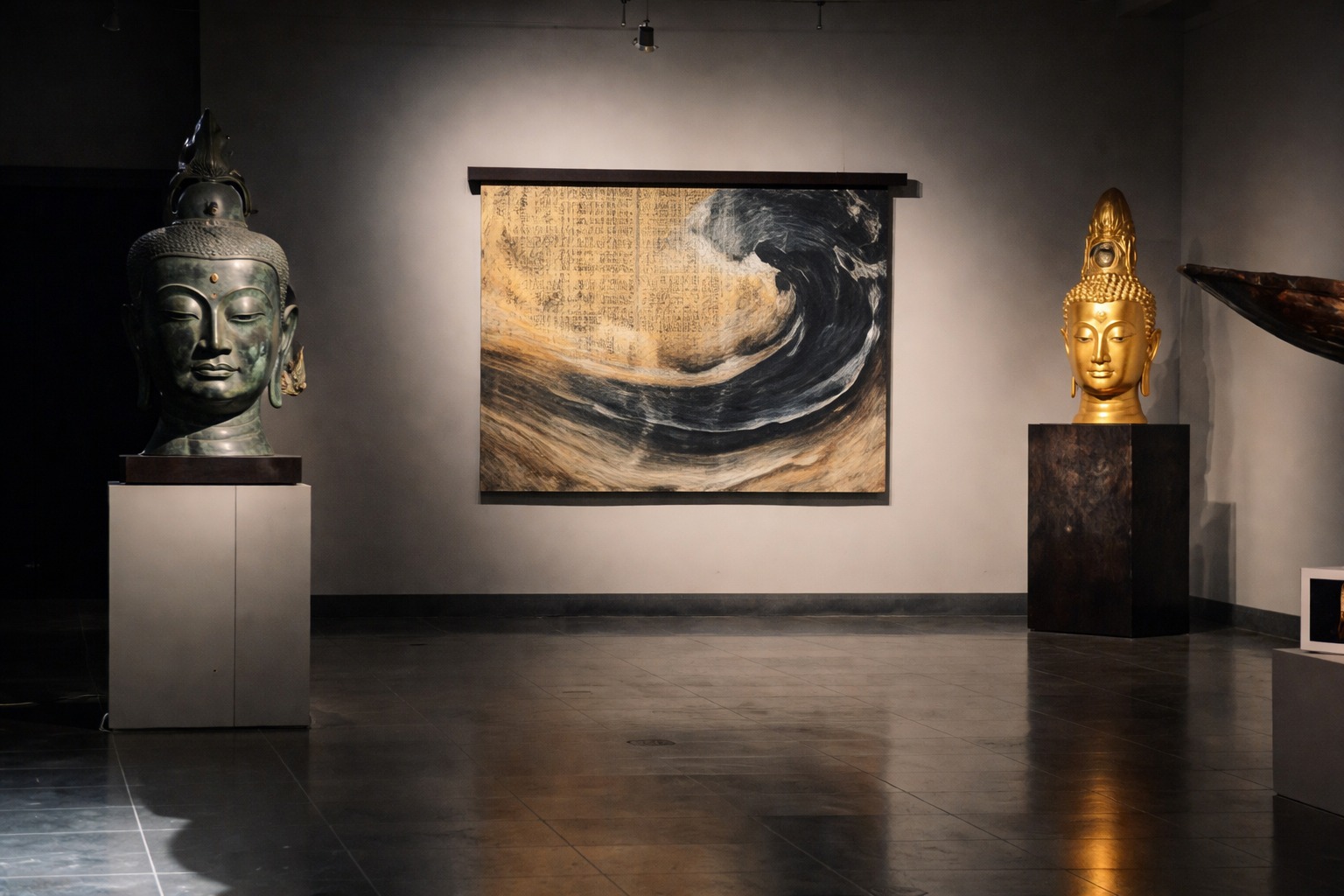
Recurring motifs most notably the meditative figure, arboreal structures, and elemental forms signal Gupta's sustained engagement with Zen philosophy and spiritual inquiry. Seated contemplative figures and expansive "tree of life" formations articulate a vision of interconnectedness between the human and the ecological. Yet these symbols resist overt religiosity; instead, they operate as archetypal presences through which silence, balance, and interiority are evoked. The works invite stillness rather than interpretation, encouraging viewers to encounter the artwork as a space of reflection.
Environmental consciousness has likewise shaped Gupta's oeuvre. Large-scale installations resembling forests, waterfalls, or organic growth extend beyond object-making into spatial experience, inviting viewers to traverse constructed environments that echo natural processes. These immersive works underscore his conviction that art should not merely be observed but physically encountered and reflectively inhabited. Material becomes environment, and environment becomes experience.
Over the decades, Gupta's works have been exhibited internationally and are held in significant public and private collections. Among his notable sculptural projects is Garuda - Surrender, presented at Bikaner House, which encapsulates his synthesis of mythological reference and contemporary material language. The work embodies themes of strength, transience, and spiritual yielding - ideas that recur throughout his practice, where myth operates less as narrative and more as symbolic resonance.
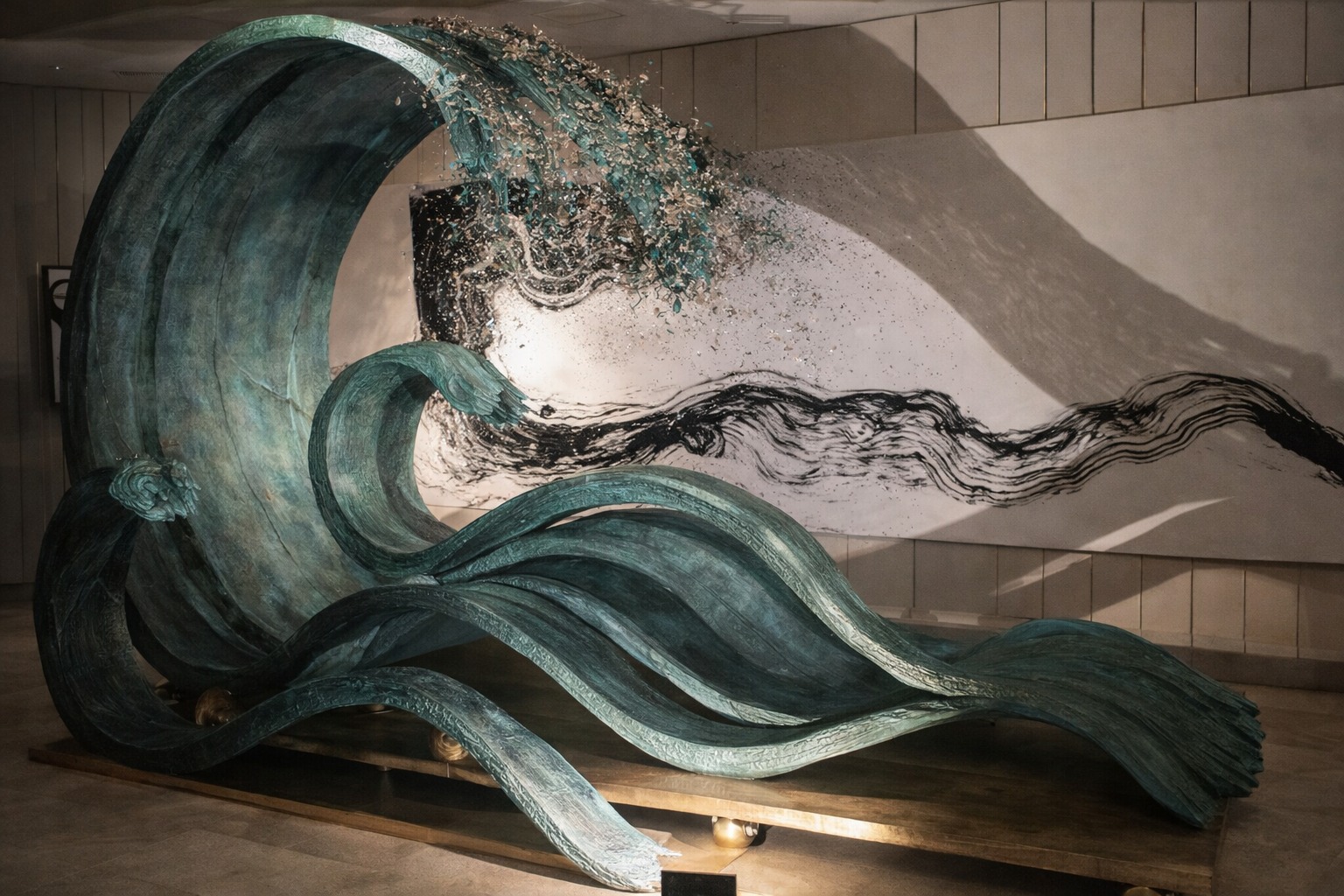
The Gujarat retrospective therefore functions not simply as another exhibition within an established career but as a consolidation of six decades of disciplined exploration. By presenting early paintings alongside recent sculptural and installation works, the exhibition illuminates the coherence of Gupta's vision. What emerges is not a narrative of stylistic reinvention but one of deepening inquiry. His surfaces have grown increasingly distilled, his forms more elemental, yet the underlying concerns rhythm, solitude, ecological balance, and meditative awareness remain constant.
The timing of this retrospective coincides with expanding global attention toward contemplative and ecologically oriented artistic practices. Within this context, Gupta's oeuvre appears prescient rather than retrospective. His insistence on slowness, repetition, and material intimacy stands in quiet resistance to spectacle-driven production and accelerated visual consumption. The works propose an alternative temporality one grounded in patience, continuity, and mindful engagement.
Conclusion
Satish Gupta's six-decade journey reflects an uncommon consistency of vision. Haiku of a Still Mind affirms his position as an artist for whom creation is inseparable from contemplation. Rather than marking closure, the retrospective underscores continuity - an ongoing dialogue between matter and mind. In bringing together the breadth of his life's work, the exhibition stands as a milestone not merely of longevity but of sustained philosophical commitment within contemporary Indian art, reaffirming Gupta's enduring engagement with silence, material, and the possibility of inner stillness.
Picture Courtesy: Bespoke Art Gallery
Bibliography
- Banerjee, Soma. Contemporary Indian Sculpture: Material, Memory and Modernity. New Delhi: Oxford University Press, 2018.
- Bespoke Art Gallery. Haiku of a Still Mind: Continuum · Consciousness · Coherence - Exhibition Notes and Press Material. Ahmedabad: Bespoke Art Gallery, 2026.
- Dalmia, Yashodhara. The Making of Modern Indian Art: The Progressives. New Delhi: Oxford University Press, 2001.
- Gupta, Satish. Inner Resonance: Writings, Poems and Reflections. New Delhi: Published Artist Writings Archive, various editions.
- Jain, Jyotindra. "Spiritual Modernism and Material Consciousness in Contemporary Indian Sculpture." Marg: A Magazine of the Arts 67, no. 3 (2016): 52-61.
- Kapur, Geeta. When Was Modernism: Essays on Contemporary Cultural Practice in India. New Delhi: Tulika Books, 2000.
- Kumar, R. Siva. "Nature, Silence and Contemplation in Indian Modern Art." Lalit Kala Contemporary, Lalit Kala Akademi, New Delhi, 2014.
- Mitter, Partha. Indian Art. Oxford: Oxford University Press, 2001.
- Seth, Anjana. "Meditative Form and Material Process in the Sculpture of Satish Gupta." Exhibition Essay, Bikaner House, New Delhi, 2019.
February 25, 2026
